How childhood trauma shapes codependency, avoidance, and perfectionism
By Nicholas Fry
“Yeah, sure, tell me how this is all about my childhood.” I hear some version of this from clients all the time, usually with an eye roll. And I get it. But one of the most fascinating parts of clinical work is watching, over and over, how our earliest patterns play out in our lives, our relationships, and the realities we end up creating for ourselves. When we zoom in, the power of those early foundations is too hard to ignore.
Between roughly ages 2 and 7, our brains are building our understanding of reality. This is when our most foundational beliefs take shape: what a parent is, what love is, who we are, and how we’re meant to interact with the world. When patterns repeat over and over, they become conditioning. Then the framing gets wrapped up, and we grow up without thinking much about these early programs.
The most powerful programming is how we received love from our parents, and what we decided that meant about who we are. Family structure, birth order, adverse childhood experiences, and our parents’ own trauma all play a role. But there’s a common thread: we trade who we are for who we needed to be to stay loved. That trade becomes a subconscious drive that follows us into adulthood. It shapes the partners we choose and the relational patterns behind most of our suffering.
Here are three common ways it takes root.
If everyone’s happy, I’m safe.
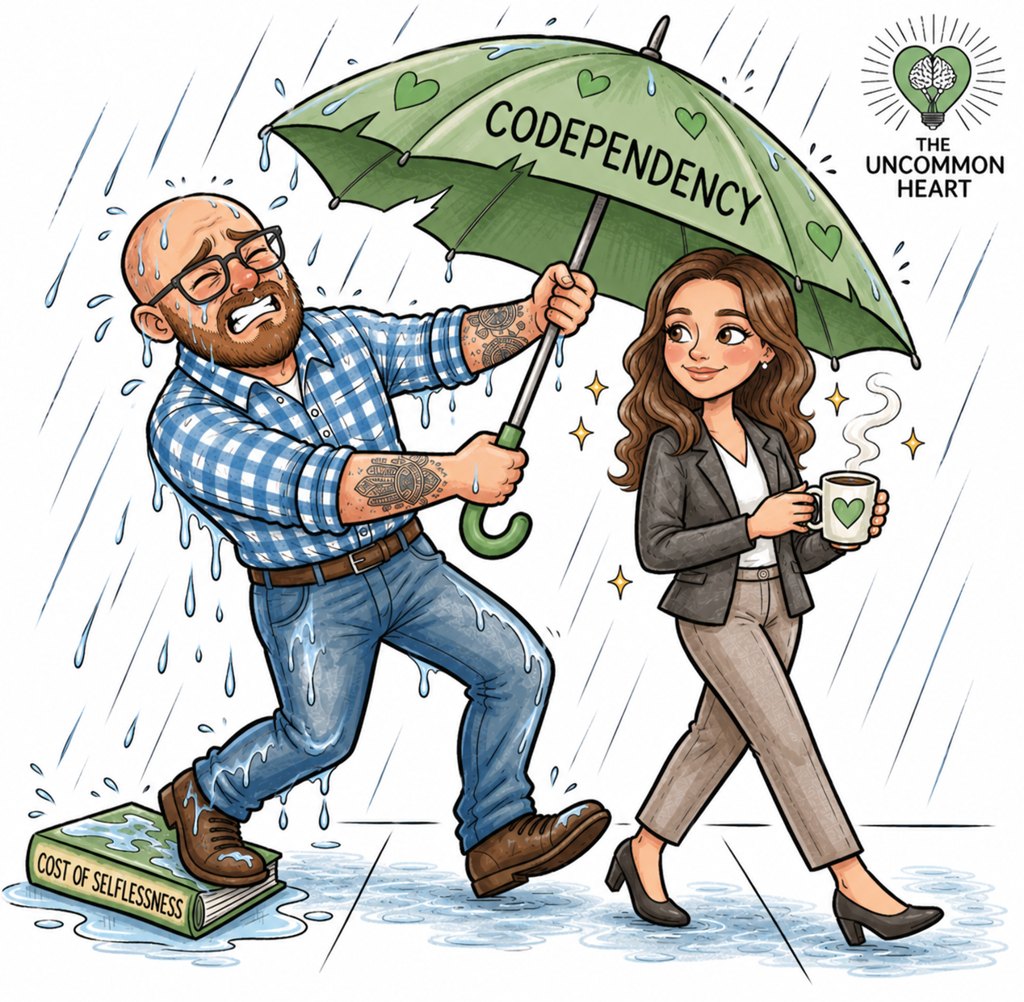
Some children learn that love is only possible in safety, and safety means keeping everyone else okay. They become helpers, hyper-attuned to the feelings of others, and often get rewarded for taking the burden off the family. In adulthood, this can look like codependency and people-pleasing: trouble setting boundaries, struggling to take care of ourselves, and being drawn to dysfunctional people who offer endless opportunities to earn love through giving.
This one is mine. I can relate to all three, but in earlier phases of my life, codependency was by far the closest match. It’s a big part of why I became a therapist. I built empathy as a survival mechanism, earned love through caring, and suppressed my own needs to receive love. I’ve worked very hard to heal from it.
The goal was never to become selfish, but to realize the cost I paid for staying self-less as a strategy to earn love.
If I don’t need anyone, no one can leave.
Others learn the opposite lesson. The roots often come from emotionally immature parents who called on a young person to hold their emotional pain. Many clients describe feeling like their parent’s therapist, or say they raised their parents. Other versions look like being made responsible for younger siblings, what we call parentification. The same childhood can produce a caretaker or someone who keeps everyone at arm’s length, depending on whether closeness came to mean I must give or I will be consumed.
When intimacy starts to feel like obligation and loss of self, they do whatever it takes to reground themselves in safety. They might pick fights to create space, go quiet for days, or even disappear without telling anyone where they’re going. It’s also a way to avoid disappointment. If you never ask, you never have to feel unloved when they don’t show up. Think about asking someone to pick you up from the airport, and then they never arrive. It can make you feel so small and insignificant, even though realistically it has nothing to do with you.
Ironically, these clients often end up with partners who can’t function independently and lean on them in codependent or enmeshed ways. There’s a simultaneous need to care and a need to get away from the caring. What they’re really looking for is interdependent love that comes at no cost or obligation. They want to be free in a relationship, like a wild horse, free to come back to the barn whenever they need connection.
Love has to be earned.
For a child who was constantly criticized, or praised only for achievement, the result is a lifelong preoccupation with not making mistakes or failing. These folks struggle with balance. They live as though they have endless capacity for career, parenting, friends, and responsibilities, and they make every one of them a target for perfection. When life reminds them that’s not possible, the helplessness can paralyze them. This anxious manager loses the ability to tell what needs to be done now from what can wait. If everything feels important, nothing is. Instead of being present in their relationships, they’re relentlessly chasing the next accomplishment.
I’ve seen how heavy this can get with clients. When our entire worth rests on the next accomplishment, the cost can be far greater than burnout. Some people are left with no sense of who they are when they run out of A’s to add to their GPA, and the mental weight of maintaining perfection can cost them their lives.
Underneath all the hyper-organization and flawless exteriors, perfectionists long for a deep sense of safety, unconditional acceptance, and relief from the burden of carrying it all. They want to be loved without the need to perform. The right to exist without producing is something they’ve never experienced, and it has never felt safe. They want to give themselves the same grace they give so many others.
When the bargain stops working
Eventually, these detours to love start to break down. The bargain that worked so well to keep us connected to our caregivers starts creating chaos in the lives of the people we love, and the trade-offs become clear.
A lot of therapy gets stuck too long in the why and the where. I always say understanding is about 10% of the problem. The other 90% is what we do with it: practicing new habits and setting new boundaries with ourselves and others, so the protection stops doing damage or limiting what’s possible for our lives.
Internal Family Systems calls these parts managers. They are parts of us that try to earn love through something external, like perfection, giving, or isolation. In almost every case, they are not a reflection of Self. And they make perfect sense. A child can’t run away or start over. They have to stay connected to the people caring for them, no matter the cost, and that often means suppressing themselves.
The way home
Leaving the program is the real work, and it involves a lot of grief, both for what the program cost us and in the discomfort of trying new patterns. It’s the inverse of the childhood lesson: as adults, we need to put our authenticity slightly ahead of our attachment needs.
Any arrangement that asks us to suppress who we are to stay loved is, by its very nature, not love.
Returning to ourselves means noticing the urge to fix, to withdraw, or to perform. Then we pause, check in with ourselves, and make a conscious choice. It’s a small, repeated habit that makes Self the decision maker, not the part we built to stay loved.
The consequences can be as deep as the rewards. In some relationships, showing up authentically creates stronger bonds and deeper intimacy. We finally learn whether someone loves us for who we are or for what we provided by living out the pattern. Other relationships won’t survive it. When we stop meeting needs the way we used to, some people won’t stay. And once we see outside these patterns, there’s no shoving ourselves back into a box that was always too small.
The journey can be lonely. But the people who leave make room for new connections, and real, unconditional, accepting love only arrives when we are truly ourselves.
So ask yourself: Where have I traded myself to stay loved? That question reveals a lot about our suffering, and even more about the way home.
If you’re struggling, call or text 988 to reach the Suicide & Crisis Lifeline.
Nicholas Fry, MSW, LCSW, is the founder and clinical director of The Uncommon Heart in Colorado Springs and a combat veteran. He helps people heal from trauma, codependency, and the patterns that keep them from living as themselves, and he facilitates Selfhood Sanctuary, our codependency recovery group.
Thank you for being part of this with us.
Want reflections like this in your inbox? Join our mailing list
Follow along on Instagram and Facebook